
Finance Minister Nirmala Sitharaman is likely to hold pre-budget consultations with industry chambers on June 20, sources said. The budget for 2024-25 fiscal is likely to be presented in Parliament in the second half of July. Industry sources said the pre-budget consultation with Sitharaman would be preceded by a meeting with Revenue Secretary Sanjay Malhotra on June 18.

If we persist in talk and little action, I think we will slip. I fear the consequences of sustained slow growth. We need strong, sustained, clever action today, Rajan said.

'The private sector believes that some enablers in labour-intensive sectors like apparel, toys, tourism, and media retail, can unlock a lot of jobs.'

Madhabi Puri Buch, the first female chairperson of Sebi, doesn't plan to rest on her laurels in her third and final year in office and has set out an ambitious goal, such as moving towards a same-day and instantaneous settlement cycle for the secondary market.

New-generation private sector banks such as ICICI, HDFC, Axis, Kotak etcetera owe their existence to the recommendations of the first Narasimham Committee.

Deputy Governor Michael Patra warned about the spillover effects of food inflation.

Some measures announced in Indradhanush -- a 7-point Modi plan to revamp State-owned banks but not completed -- may be taken up again.

A paper authored by Rajan said, state-linked banks can be a first step in altering the ownership structure of some PSBs, where the government brings down its stakes to below 50 per cent, creating distance from operations of banks, and improving governance along the way.

A gradual approach to privatise public sector banks (PSBs) is more ideal than taking a big-bang approach, a study by Reserve Bank of India (RBI) staff has concluded. It has backed the government's idea to privatise two PSBs initially. Such a gradual approach would ensure that large-scale privatisation does not create a void in fulfilling important social objectives of financial inclusion and monetary transmission, the study has argued.
Prime Minister Narendra Modi will on Friday launch two schemes of the Reserve Bank of India (RBI) that may go a long way in changing how the household sector invests, and complains if anything goes wrong with their savings. These schemes - retail direct and an integrated ombudsman - will be launched by the Prime Minister virtually, in the presence of Finance Minister Nirmala Sitharaman. With the introduction of retail direct, a common man can directly take a position in government securities (G-Sec), considered to be the safest asset class a sovereign can offer.

Among the 30 Sensex companies, Larsen & Toubro, Power Grid, NTPC, State Bank of India, Reliance Industries and HDFC Bank were the biggest laggards. Sun Pharma and Nestle were the only gainers.

The talk of governance reforms at public-sector banks seems to remain on paper, as a majority of them continue to be working with just a handful board members. Half of the board seat at these banks have been vacant. Ten of the 12 public-sector banks, even large ones like Punjab National Bank, Canara Bank and Union Bank of India - all except State Bank of India (SBI) and Bank of Baroda - don't even have a chairman. In 2014, while splitting the post of chairman & managing director (CMD), the government had decided to appoint non-executive chairmen at these banks. SBI, which has an executive chairman and four managing directors, was an exception.

In her fourth tranche of the economic package, she said commercial mining will be done on revenue sharing mechanism instead of the regime of fixed rupee/tonne.
The Centre's proposal to call for governance reform in the RBI could, however, take a back seat, a source privy to the development said.

As deputy governor, Patel headed the RBI panel to draft the monetary policy report, which became the basis of the ongoing reforms at the apex bank

The use of RBI capital to strengthen public sector banks will have many positive implications for the economy -- and a few manageable downsides, points out R Jagannathan.
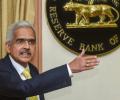
'His (Das) approach to work seems that of working as a team with ease in communication.'
RBI says haste in easing norms for banks harmful to economy.

While RBI is likely to cut repo rate by 25 basis points on Wednesday, the government is also expected to push reform initiatives like increasing FDI limit in insurance sector in the Budget session, it added.

'I am shocked that the BJP makes so many commitments. What did they deliver as the NDA?'
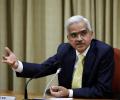
Reserve Bank Governor Shaktikanta Das on Wednesday said the country is at the doorstep of economic revival on the back of accommodative monetary and fiscal policies being pursued by the central bank and the government.

Asked when the economy will revive, Das said it is difficult to make an estimate as there are many things which are still playing out.

Lauding the government and RBI for saving the day for India with conservative banking norms, ICICI Bank chairman KV Kamath said on Monday any further reforms in the sector should wait as global banks are in 'disarray'. Expressing his views on RBI deferring the liberalisation of foreign banks, the ICICI Bank chairman said: "I think it is entirely appropriate that they have said they will review it at appropriate time."

The Budget, to be presented on February 1, is likely to be less worried about fiscal deficit and will be focused more on nursing the fragile growth, according to a Wall Street brokerage report. Bank of America Securities India expects the budget to peg "fiscal deficit at a high 5 per cent of GDP for FY22 and 7.2 per cent for FY21, as it is likely to step up capex, recap public sector banks, push asset sales to break government monopolies, offer sops for real estate, tax cuts for lower income groups and creation of a bad bank". Its house economists expect these spends to be funded by debt and partly by imposing a cess on high income groups and also by some non-fiscal measures like tapping the central bank's revaluation reserves and bank recapitalisation and infra bonds.

This is because the bond market has factored in the Rs 4.88-trillion gross borrowing for April-September 2020.
Moody's has cautioned the government against targeting double-digit gross domestic production expansion saying any growth beyond 7 per cent without reforms will fuel inflation that will result in 'more painful' future adjustments.

The central bank dashed hopes of any steep interest rate reduction.

India needs a second green revolution along with the next generation of reforms with a view to make agriculture more climate-resistant and environmentally sustainable, said an RBI article on farm sector challenges. Observing that Indian agriculture has exhibited remarkable resilience during the COVID-19 period, the article said "new emerging challenges warrant a second green revolution along with next-generation reforms". Despite the success in terms of production that has ensured food security in the country, food inflation and its volatility remain a challenge, which requires supply-side interventions such as higher public investment, storage infrastructure and promotion of food processing, said the article titled 'Indian Agriculture: Achievements and Challenges'.

'To simply let the rupee depreciate to any level according to market forces will not be in the country's interests.'

The Budget should use the extra RBI surplus to better effect, suggests A K Bhattacharya.

Y H Malegam, 80, will head the panel that will look into non-performing bank assets and their relation to the Rs 114-bn PNB scam.
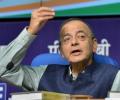
Years before the Supreme Court struck down as 'unconstitutional' an opaque political funding tool that allowed individuals and companies to donate money to political parties anonymously and without any limits, the then finance minister Arun Jaitley -- the prime mover of electoral bonds -- had termed them legitimate and transparent.

Investors' wealth soared by Rs 10.58 lakh crore in three days of the market rally, where the BSE benchmark jumped over 2 per cent, and hit an all-time high on Monday. Extending its winning momentum to the third day running, the 30-share BSE Sensex jumped 363.20 points or 0.49 per cent to settle at 74,014.55. During the day, it zoomed 603.27 points or 0.81 per cent to hit its record high of 74,254.62.

Managing Brexit, inflation and banking reforms, along with the political environment, will be tough.

'We have essentially tried to set out an agenda for the next five years and it, in essence, represents the political commitment to that agenda.'

Governments that did not respect the central bank's independence would sooner or later incur the wrath of financial markets, ignite economic fire, and come to rue the day they undermined the regulatory institution, Deputy Governor Viral Acharya warned.

Tension between the government, specially the finance ministry, and RBI is as old as the central bank itself.

The year 2014-15 could well go as one of long-pending financial sector reforms, expected to have a lasting impact.

Bankers seem to be pleased with the government for keeping its promise of not interfering in operational matters, but are apprehensive about the intense scrutiny of their functioning.
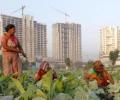
The land acquisition bill is a catalyst to investment and passing the bill will improve India's business environment.
 © 2026 Rediff.com - Advertise with us - Disclaimer - Privacy Policy - Sitemap - Feedback - About us - Terms of use - Grievances